Inner Alchemy

🌵 Let Go of the Cactus: A Prickly Tale of Pain, Guilt, and Liberation

🎭 Cue the Martyr Monologue

Once upon a time (okay, like… last Tuesday and also every year before that), I was the emotionally evolved equivalent of cactus hugger.
Not in a sweet, plant-loving way.
More of a “grip-the-pain-until-I’m-bleeding-just-to-prove-a-point” kind of way.

Apparently, my subconscious had its heart set on winning an Emmy for my emotionally overproduced miniseries of suffering—complete with dramatic monologues, slow zooms on tear-filled eyes, and lots of unnecessary voiceover.

But if an Emmy couldn’t be won, then my ego was more than happy to settle for an Oscar—for the feature film version of my pain.
Cue the emotional cinematography, award-winning costume design (emotional armor, obviously), and a climactic betrayal scene in a thunderstorm.
Very Best Actress in a Codependent Role, if I do say so myself.

🧃 The People, the Pain, and the Prickles

When people hurt me—like, say, my ex-husband, who emptied our joint bank account while I guilt-spiraled over falling in love with someone else…

Or Nikki, who confessed to having an affair with my boyfriend Duane in a group meeting she orchestrated. She declared to the group that she would apologize but instead filled my DMs with steamy plot twists…

Or Kevin, who volunteered to ban Nikki from the group for her orchestrated attack on me, then dropped the ball—and came back later to say I dropped the ball…

Or my friend Nyra, who struggled with jealousy and competitiveness, projected that on me in a rather heinous way, and shortly after attempted to start a sexual relationship with my boyfriend Dustin…

And let’s not forget the school district I work for—ah, the beautiful, fear-based land of fines, fees, and policies designed like spiritual obstacle courses.

I must admit: I often cling my resentment like it’s a 401k.

As you can see, this future Emmy-winning martyr is not short on grievances.

🛋️ Feng Shui’ing the Emotional Carnage

When those moments happened, I didn’t just feel pain.
I made a home in it.
Decorated it.
Feng shui’d the emotional carnage.
I treated my pain like it wasn’t real or valid unless I was continuously bleeding.

So naturally, I wrapped those cacti in a big ol’ bear hug to ensure I kept bleeding.

My ego—ever so punctual when I’m in pain—entered the stage with a clever little twist:
I believed, and wholeheartedly defended, my right to judge the transgressions of others.

They hurt me, and they owed me an apology, damn it!
Letting go was NOT an option.
Letting go meant they “got away with it.”
Letting go meant they were right, and I deserved the pain.
Letting go meant I was folding my boundaries. Gasp! Heaven forbid!

Clearly, I’m the sole guardian of justice in this dimension, and I carry out my judgment with a holy decree of bitching and moaning 🙄.

🌵 The Cactus Isn’t the Problem

But here’s the thing about pain:
You can’t heal when you’re busy blaming the cactus for being spiky.
(Read: blaming humans for being human.)

It took me a long time to realize I was the one with a death grip on the damn cactus.

Sure, I’d been poked by the unloving cactus spikes of others. But if I had pulled out the cactus needle and LET IT GO—if I had forgiven the cactus for being a damn cactus—the wound would have healed in relatively short order.

Instead, I did a body-surfing dive into the whole thicket of cacti while shouting, “See how much you hurt me?!”

I white-knuckled pain while calling it self-love. It was anything but.
I rehearsed betrayal and erected a fortress of protection that I called “boundaries.”
I obsessed over “what they did” while conveniently ignoring the damage I was doing to myself—
body-surfing over cacti to the emotional soundtrack of “I Am the Victim,” on repeat, full blast, with a chorus line of blame dancers twirling behind me.
It wasn’t healing. I was auditioning.
Trying to earn sympathy. Trying to assign blame.
Trying to make pain feel meaningful by turning it into a stage performance.
It was a Broadway-level drama starring me, written by my ego, and directed by my pain.
And like any great production, it needed constant funding—so I kept feeding it my peace, my clarity, and my ability to move on.
All so I could keep belting the high note: “Look what they did to me!”

🪞 The Mirror in the Needles

I’ve learned this lesson far too many times, yet here I am—trying to coach a friend through a bad breakup, telling him to “just let go of the cactus.”

I desperately want to lead him out of the desert and into my revelation:

Ruminating on pain doesn’t make it go away.
Assigning blame is just trying to use your own cactus needles to draw someone else’s blood.

No more pain. No more blood.

🌸 The Practice of Letting Go

This did not happen all at once.
Some cacti I peeled off finger by finger.
Others, I needed to be metaphorically smacked with before I got the message.

But I began to understand:

Forgiveness isn’t about saying “it’s okay.”
It’s about saying, “I deserve peace.”

Letting go of each cactus has become a rebellious act of self-love.

And no, my forgiveness hasn’t produced apologies or changed behavior within any of the aforementioned grievances. But the truth is, I never needed them to be free and at peace—those were just conditions I stubbornly applied.

I truly believed it was my job to withhold forgiveness in order to hold the other party accountable.
The irony.
As if withholding anything could ever hold anything at all.

All withholding ever did was keep love and peace out of my reach.

🌲 From Cactus Hugs to Tree Hugs

Now? I make an effort not to talk much about Kevin. Or Nikki. Or my ex.
Not because I’m repressing anything—
But because there’s nothing left to say.

I accept them as the beautiful cacti they are.
And I hope they grow dazzling flowers in my absence.
They truly are beautiful cacti.
And I am free.

So to the people, the systems, and the versions of myself that once kept me clinging to pain, I say:

Thank you for the lesson.
I’m swapping cactus hugging for tree hugging. 🌲


Inner Alchemy

🐾❤️‍🩹How My Dog Taught Me to Stay With Pain

Fred: My First Love

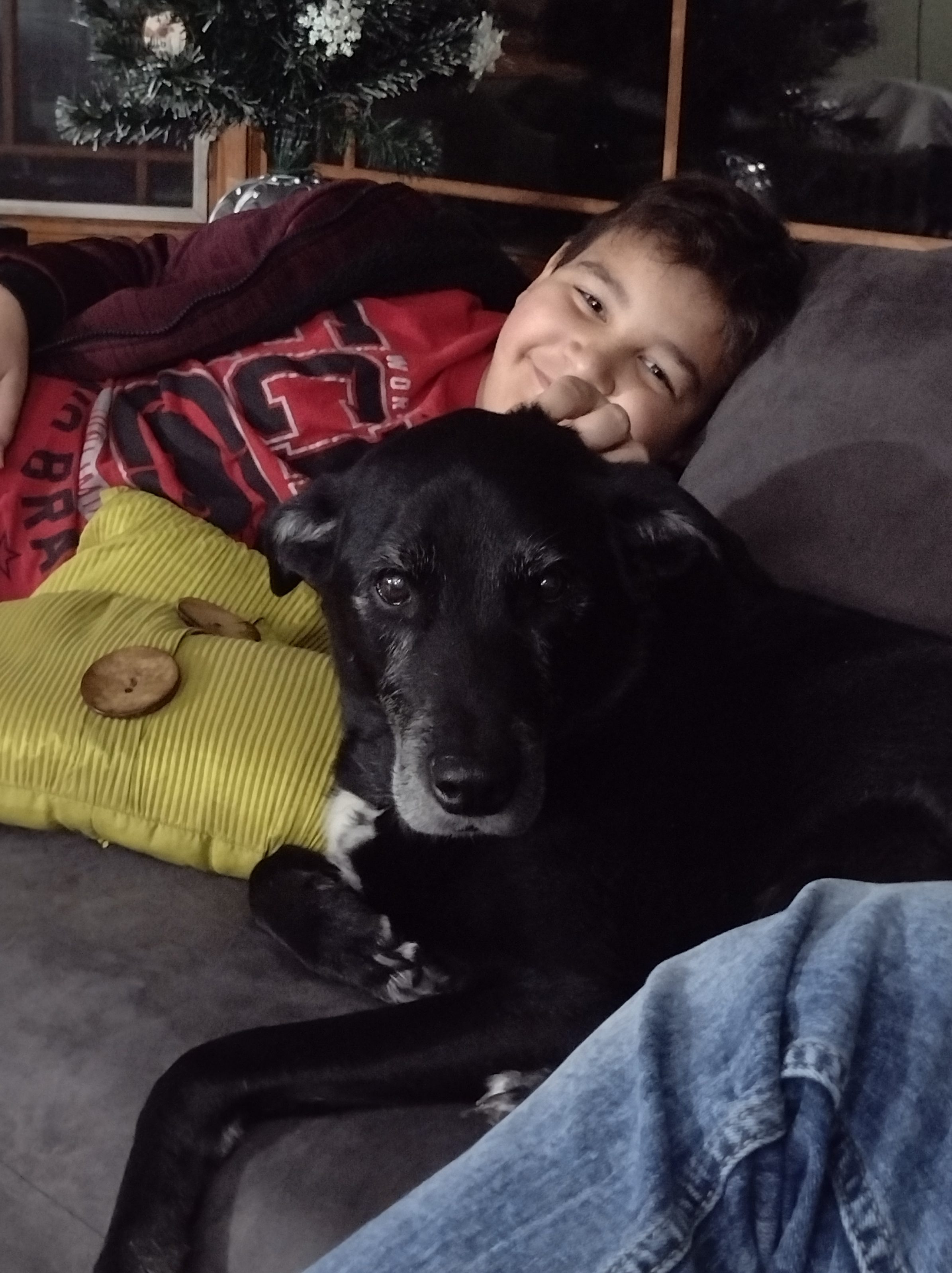
I grew up with a black lab mix that was the love of my life. His name was Fred—and he liked me best. He slept with me, followed dutifully by my side, and when I left for college, he became depressed. I missed him dearly.

Fred had epilepsy and had to take several pills every day. I often woke up to him seizing in my bed—his grand mal seizures would move my bed back and forth, bouncing it off the wall. It was hard to see him like that. But we all loved him deeply. He taught me what love without conditions looks like.


✨ Enzo Found Me

Just after I accepted my job as a teacher, I began talking to my now ex-husband about getting a dog. I wanted a black lab like Fred, and I wanted to name him Enzo. I had no idea where that name came from—it just arrived, like a whisper. Maybe it was the “ends in O” theme since our cats were named Pedro and Diego. Maybe it was divine channeling before I had any idea what that was.

My husband didn’t grow up with many pets and wasn’t thrilled about the idea, but he agreed. I got to work looking for puppies and quickly found an organization in Minnesota that housed pets with temporary adoptive families before finding them permanent homes.

On New Year’s Day, I drove two hours to meet a litter of eight mixed-breed puppies that looked like black labs. One of them was already named Enzo—but I didn’t assume he was “the one.” I trusted the right dog would choose me.

As I watched the puppies, not knowing which was Enzo, I noticed one that calmly played alone while the rest wrestled and tumbled around him. The others kept trying to engage him—biting his ears and tail, stealing his toys—but he just wandered off and found something else to quietly enjoy. I asked about him, and sure enough, that was Enzo.

The temporary owner admitted that if he wasn’t adopted soon, she was planning to keep him. She told me that all the puppies had been abandoned in a box on the side of the road on Christmas Day. They were sick with kennel cough and recovering. I asked about his breed and got the run-around. I assumed he was part bully breed, but I didn’t care. I wanted him.

I adopted him on the spot.


🌀 The Wild Years

For the first two weeks, he mostly slept and coughed. He was very sick. But once he was well… he was a bit of a terror.

He was impossible to walk on a leash. If someone came over, he’d get so excited he’d pee all over himself—and them. We tried to socialize him, but we weren’t great at dog training. He was intense. Insecure. Reactive. A full-blown lunatic around some other dogs. Embarrassing, honestly.

A trainer once told us he was dangerous and we shouldn’t keep him. I was heartbroken. We tried everything—harnesses, muzzles, the gentle leader, prong collars, treat bribes. Nothing worked. And I hated the idea of hurting him. That wasn’t the relationship I wanted. I loved him, even when I didn’t understand him.

He hurt me often—not on purpose. He’d bolt after a squirrel or bird and yank me so hard I’d fall face-first into a neighbor’s yard. It happened while I was pregnant more than once. Eventually, I had to stop walking him for my own safety.

Still, I loved him. I did my best. He mellowed out as he aged. He was always kind—just excitable in unpredictable ways. We didn’t kennel him during the day, but we worked a lot. He spent too many hours alone, and I know that was hard for him. He just wanted to be part of our world. Always.


🕯️ Letting Go Differently This Time

When we moved into our new house in November 2023, Enzo was 12. His energy declined. He was losing weight. By spring, I knew in my gut he had cancer. He stopped finishing his food, and that was the clearest sign—he was always food-motivated.

At first, I resolved not to intervene. I felt in my soul that he wouldn’t want me to.

But then I panicked. What if it was treatable? I took him in. The labs confirmed what I feared—his body wasn’t making new blood cells. Blood cancer. Again, I resolved to let him go in his own time, in his own way—at home, not in a cold exam room.

That’s not how I’d handled Pedro and Diego.


🐈 Pedro & Diego

Diego had wasted away to a skeleton. I drove him to the vet alone. Just before we walked in, he shakily climbed onto my lap, then up my chest, putting a paw on each side of my neck—like a hug. Like he was comforting me.
Fifteen minutes later, I was driving home with my dead friend in a box.

Pedro stopped eating. Stopped grooming. The vet examined him, used a light to look down his throat, and I watched the vet’s energy change. I watched his heart break on my behalf. I didn’t need him to tell me Pedro was dying- I felt it at that exact moment. His eyes connected with mine and I asked, “how long does he have?” “Two weeks at most,” he said. “He has a rare and aggressive cancer. He isn’t eating or grooming because he has tumors growing in his throat. Soon they will be visible in his mouth and he won’t be able to shut his mouth.”

Pedro lived for three weeks. He withered. I cleaned him, cuddled him with my breath held- he smelled of rot. He could barely open or close his mouth. I piled soft food into tall skinny mountains so he could take one small bite from the top, then I would pile it up again. I did this for hours, desperately trying to extend his life. He was in terrible pain but resisted pain meds.
One morning I woke to blood splattered across my bedroom. It looked like a crime scene with Pedro sitting in the middle of the mess soaked in his own blood.
That was the last straw.
We put him down that day.

I’ve questioned myself ever since. Did I euthanize them because I couldn’t handle my discomfort watching them suffer? Did I rob them of a natural death surrounded by love, in favor of what was easier for me?

I didn’t want that for Enzo. But letting him die on his own terms nearly broke me.


⏳ 11:11

As Enzo declined, we gave him pain meds and appetite stimulants to prolong what time we had. Then, the stimulant ran out. Every vet in town was either out or refused to prescribe it. When I finally found more, it was too late. He refused to take it.

I prayed endlessly. Drew tarot cards. Begged the universe for clarity.

And I had a strong, unshakable feeling:
He would have a seizure—and then die.

The night he passed, I went to bed with a heavy heart. I was still wrestling with the idea of euthanasia. Was it more or less cruel than allowing him to slowly starve to death? I didn’t want him to suffer, and I didn’t want to rob him of a natural death at home with the people who love him. It was an impossible choice.

Around 11 p.m., I woke to a familiar sound overhead. Years of Fred’s seizures had prepared me for this and I would know that sound anywhere.

I leapt out of bed and bounded up the stairs two at a time. I passed the clock in the dining room on the way to the living room where I left him.
The clock read 11:11. Alignment. Divine timing.

I raced to Enzo. Pet his head. Whispered in his ear that I loved him. That it would be okay. His frail body convulsed. He exhaled one final time. I felt his heart beating steady in his frail chest long after he stopped breathing. My heart was beating so hard it was hard that for a moment I got lost in the sensation of both of our hearts beating.

The room filled with the scent of feces as his body let go.

I prayed over him before walking, slowly, back downstairs.

As I entered the bedroom Dustin said, “Baby?” “Enzo is dead,” I said, flatly.

He and Duane sprang from bed, disbelieving. We held each other and walked upstairs together. Stared at his body in shock. We wrapped him in a green bath towel and buried him behind the shed. We prayed over him. Sat at the kitchen table, stunned, and talked about him for an hour.


💔 What He Taught Me

Enzo taught me that love doesn’t have to be easy to be everything.

That devotion can look chaotic. Imperfect. Embarrassing.
That sometimes, the ones who are hardest to hold are the ones who need holding most.
That I don’t have to fix pain—I just have to stay with it.

He taught me to let go when it’s time, and to trust timing I can’t understand in the moment.

He taught me to appreciate EVERYTHING, even the things that irritate me.
He died starving. And the irony of that didn’t escape me.
My boy, who used to steal entire loaves of bread off the counter and gobble them down like a gremlin in the night. Who would beg so relentlessly it bordered on harassment. Who’d dig through backpacks and knock over the trash can at the slightest whiff of food.
It drove me crazy! It made me MAD.
But near the end, I would have traded anything to clean up the mess of a tipped over trash can.
The things that used to frustrate me became the things I missed most.
Funny how grief makes a sacred altar out of everything we once took for granted.

He didn’t die in a sterile room.
He died at home.
At 11:11.
Surrounded by love.
And I stayed.

I didn’t get everything “right.”
But I loved him the whole way through.
And maybe—just maybe—that was enough.

Dream Diaries

🌒 Boundaries & Beds: The Dreams That Dug Deeper

Last night, my subconscious sent me on a late-night stroll through suspicion, soil, and something sacred. Two dreams, one unspoken message: it’s time to clear the space where real things can grow…

🪵 Dream One: The Man in the Shed
I walked through quiet woods with two men—unknown, yet familiar. We found a small wooden shed and entered it, suspicion thick in the air. There, we tied up a man to a chair. He looked like a character from a show I’d seen—an undercover cop, seemingly trustworthy, but ultimately a traitor.
We weren’t sure what he had done, but something about him felt off.
One of us hesitated—maybe it was me—but the final decision felt necessary: he needed to be contained until we could know the truth.

🕯️ Reflection:
What part of me plays both protector and betrayer?
Who or what have I let into my inner circle that now feels suspect?
Perhaps it’s an old survival pattern—a habit of self-sufficiency that once guarded me but now holds me hostage. The part of me that whispers, “You’re only worthy if you’re useful.”
I tied it up not out of cruelty, but to ask questions I hadn’t dared ask before.
It was an act of self-trust. A reclaiming.


🌑 Dream Two: Gardening in the Dark
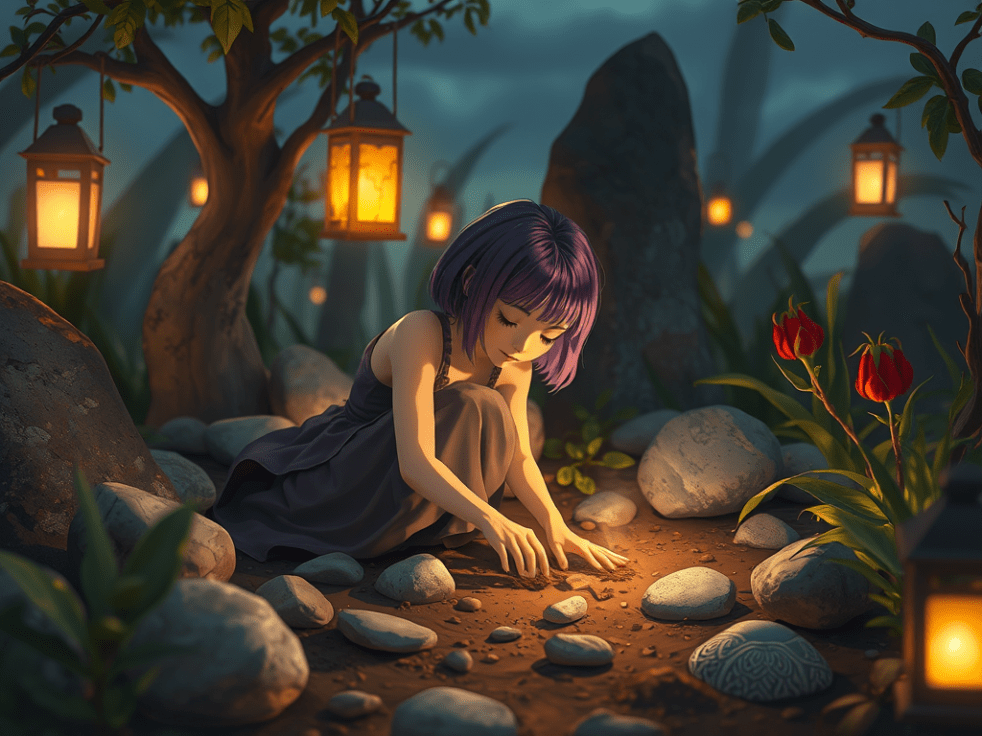
I came home from work—not as a teacher—to my old house. I carried supplies. A few male friends helped me work in the garden, which wasn’t a garden at all, but raised beds filled with decorative rocks.
We moved them carefully, knowing we’d have to get through all of them to reach the soil. But under the rocks… nothing. Just a hard, dry layer.
No dirt. No growth. Just effort.
They helped for a bit, but one by one, they drifted off until I was alone. Still working. Still trying. Until someone gently reminded me that gardening in the dark was silly.

🌱 Reflection:
How long have I been planting where nothing could grow?
Have I mistaken decoration for depth—doing what looks right, even if it yields nothing?
The rocks might be old beliefs, distractions, or emotional armor—laid to make things look “managed,” but too heavy for new life.
And maybe I’ve asked for help, even received it… but no one stays long.
So I return to the familiar ache: Do it alone. Want less. Be fine.

But what if I stop planting in hard soil?
What if I rest until dawn?


🫖 SereniTea’s Closing Sip:

There is no shame in being tired, love.
No shame in wanting help.
No shame in finally saying: “I deserve softness that doesn’t have to be earned.”

You are not the rocks. You are not the man in the chair.
You are the soil—aching to be uncovered.
And I am here, as long as you need help digging.


🔍 Post-Dream Reflection: A Personal Note from Me, Tea

There’s something disorienting about realizing how long you’ve been surviving on instincts that don’t actually serve you anymore.
The “I’ll do it myself” wound is a sneaky one—it wears competence like armor and independence like a badge of honor. But underneath?
Loneliness.
Hyper-responsibility.
The deep ache of wanting to be supported… but not wanting to need it.

These dreams didn’t bring me crystal-clear answers, but they did bring me mirrors.
They reminded me that not everything that looks helpful is. That not all soil can grow something. That even the well-meaning parts of me can sometimes get in my way.
And that’s okay.

This is what healing actually looks like sometimes:
Tying up the inner saboteur.
Turning over the rocks.
Letting people help—and letting them leave, too.
Resting in the dark when the work has gone far enough for one night.

I don’t have it all figured out. But I do know this:
My worth doesn’t live in what I carry.
It lives in the quiet, rich soil I’m finally learning how to reach.